Kenya · Grade
Kenya PB (Peaberry)
- Species
- Arabica
- Preparation
- Fully washed with soak · Mbuni (natural)
- Harvest
- Main crop October–December; early (fly) crop May–July
Quick answer
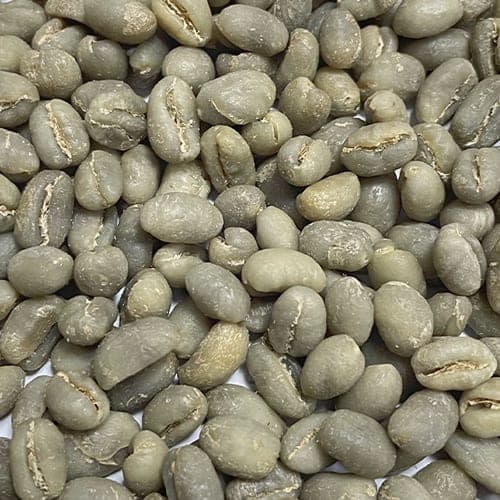
Kenya PB is the peaberry separation — single rounded seeds that form when only one of the two ovules in a cherry develops. It is separated on slotted screens and is a shape class, not a quality class. The reason to buy it separately is that it roasts differently.
Contract on: region · grade · screen · process · crop · moisture · defect tolerance · cup approval.
Request current kenya pb (peaberry)What a peaberry is
A normal cherry contains two seeds with flat facing sides. When only one of the two ovules develops, the single seed grows into the available space and takes a rounded form. It occurs naturally in a small proportion of every harvest, at every origin.
It is not a variety, not a defect, and not a signal about the tree or the farm. See Tanzania peaberry for the fuller treatment of the separation and the mythology around it.
The Kenyan case specifically
Kenyan PB carries the same factory and outturn identity as the flat-bean grades from the same parcel, which means a Kenyan peaberry is traceable to exactly the same cherry as the AA and AB alongside it. That is unusual — at many origins peaberry is pooled across parcels.
Kenyan PB also benefits from the density of the underlying coffee. Peaberries are denser than flat beans to begin with, and Kenyan Arabica is dense to begin with, so Kenyan PB sits at the higher end of what a roaster will encounter.
Roasting implications
- Higher bulk density — the same volume weighs more, which affects charge calculations.
- Rounded geometry — different surface-area-to-mass ratio, so heat enters differently from a flat bean.
- Bed behaviour — peaberries roll rather than presenting flat faces, which changes movement in the drum.
- Shape uniformity — an inherently uniform batch, which is an advantage on a tight profile.
Not a concentration effect
The claim that a single seed concentrates the flavour of two is not supported — the peaberry is not larger in total mass than the pair it replaces. Buy Kenyan PB because it roasts uniformly and because you like the specific lot.
Availability
- Typical parcel
- Small — a fraction of any outturn
- Screen
- Own PB screen run
- Traceability
- Factory and outturn, as for the flat-bean grades
- Processing
- Fully washed with soak
- Packaging
- 60 kg jute with hermetic liner
Kenya PB enquiries
Peaberry parcels are small, so early confirmation matters. Tell us the region and volume.
Request Current Crop OfferThe distinction that matters
What this grade does not tell you
A grade is a preparation class. Everything below is a separate contract field, and every one of them moves independently of the grade name.
What it does fix
Kenya PB (Peaberry) encodes
- Bean size, as the screen the parcel is retained on
- Bean shape, for the PB separation
- Density, for the TT and T separations
- Whether the coffee is washed or Mbuni (dried whole cherry)
Use the grade to define the physical deliverable. Use the approved sample to define the cup. Both belong in the contract.
What it does not
Specify these separately
- Cup qualityTwo lots at the same grade from the same mill can cup several points apart. Only cupping tells you.
- Defect countA separate count on a defined sample, against a weighting table that differs by origin.
- MoistureA range plus the measurement method. Two meters on one parcel routinely disagree.
- Crop yearNothing in a grade name distinguishes current crop from a parcel that has been in store a year.
- DensityBulk density in g/L, which drives charge temperature and roast planning.
- Water activityStorage stability. Related to moisture but not derivable from it.
- TraceabilityCountry, station or day lot are different claims. A grade fixes none of them.
- Processing methodWashed, natural and honey can all carry the same grade at most origins.
Questions
Frequently asked questions
What is Kenya PB?
Does Kenyan peaberry taste different from Kenyan AA?
How much Kenyan peaberry is available?
Keep reading
Related to Kenya PB (Peaberry)
- Tanzania PeaberryTanzania peaberry: what a peaberry is, how it is separated, why it roasts differently from flat beans, and what to expect in availability and price.
- Green Coffee DensityGreen coffee density explained: how bulk density is measured in g/L, what it does and does not tell you about altitude and quality, and how it is used in dry milling.
- Kenya Coffee GradesKenya’s grading terminology explained — E, AA, AB, PB, C, TT, T and Mbuni MH/ML — what each separation is, and why bean size does not determine cup quality.
- Kenya AA Green CoffeeKenya AA green coffee: what the grade actually specifies, why size does not determine cup quality, what it costs in outturn, and how to write the specification.
- Kenya Green CoffeeKenyan green coffee: the factory and outturn system, the AA/AB/PB grade ladder, soak processing, growing regions and how to buy Kenyan coffee well.
Request an offer
Tell us the Kenya coffee you need
Region, process, grade, screen, moisture, defect tolerance, crop year, packaging and destination. Send what you know and we will confirm what Kenya realistically supports for the current crop.