Processing
Coffee Processing Methods
The chain
From cherry to export preparation
Every method shares the same skeleton. What differs is when the fruit is removed and how much of it stays in contact with the seed during drying.
- Cherry reception, floatation and sorting
- Pulping — skin and pulp removed
- Fermentation, 12–36 hours
- Washing and channel grading
- Optional clean-water soak
- Drying in parchment to target moisture
- Rest in parchment
- Hulling, screening and sorting
Compared
The methods side by side
Read down the columns to choose a preparation; read across the rows to see what changes when you do.
| Method | What happens | Cup tendency | Where the risk sits | Typical origins |
|---|---|---|---|---|
| Washed | Cherry is pulped, the remaining mucilage is removed by fermentation and washing, and the parchment is dried. The cup reflects the seed and the terroir more than the fruit. | Cleaner, more transparent acidity and a lighter body than the same cherry processed dry. Origin and variety character reads more clearly; defects also read more clearly. | Requires reliable water, effluent management and disciplined fermentation control. Over-fermentation produces sour and phenolic cups; under-fermentation leaves mucilage that stains parchment and slows drying. | The default for Kenya, Rwanda, Burundi and Tanzanian Arabica; a large share of Ethiopian Yirgacheffe and Sidama; the WUGAR designation in Uganda. |
| Natural | Whole cherry is dried intact, then hulled. The fruit stays in contact with the seed throughout drying, which is what drives the characteristic sweetness and body. | Heavier body, lower perceived acidity, pronounced fruit sweetness — berry and tropical notes in Ethiopian lots, dried fruit and spice in Ugandan DRUGAR. | The highest-risk process to execute. Uneven drying produces mould, ferment and phenolic taints; the defect is invisible in the green and only shows in the cup. Requires space, labour and settled weather. | The default for Ugandan Robusta and Ethiopian Harrar and Djimma; a substantial and growing share of Ethiopian Sidama and Guji; increasing volumes in southern Tanzania. |
| Honey | Cherry is pulped but the mucilage is left on the parchment during drying, in a controlled fraction. Sits between washed and natural in both process and cup. | More sweetness and body than washed, more clarity and structure than natural. Acidity is usually rounded rather than sharp. | The sticky parchment is prone to clumping and surface mould in the first two days. Requires bed space and labour comparable to naturals with the sorting discipline of washed. | Produced in limited volumes across Rwanda, Burundi, Tanzania and Ethiopia. Availability is small and lot-specific, so it should be confirmed rather than assumed. |
| Semi-washed | Parchment is removed at an elevated moisture content partway through drying. Rare in East Africa but occasionally encountered in Rwandan "ordinary" preparations. | Heavier body, lower acidity, earthy and herbal notes. The green appearance is characteristically dull and bluish. | Hulling at high moisture bruises the seed and creates entry points for mould. Not used for specialty separations in this region. | Mainly associated with Indonesia. In East Africa it appears occasionally in lower-grade Rwandan and Burundian parcels. |
Unit operations
What each method actually does
The step lists below are the mill's view rather than the marketing one. They are also where the cost and the labour sit.
Fully washed (wet processed)
Read more about Washed processing- 01Cherry reception, floatation and hand sorting to remove unders, over-ripes and foreign matter
- 02Pulping to strip the skin and most of the pulp from the seed
- 03Fermentation in tanks — typically 12–36 hours depending on altitude and ambient temperature
- 04Washing and grading in channels, which also separates by density
- 05Optional soak (standard in Kenya, common in Burundi) in clean water for a further 12–24 hours
- 06Drying on raised beds or patios in parchment to the target moisture
- 07Rest in parchment, then hulling, screening, density and colour sorting at the dry mill
Natural (dry processed)
Read more about Natural processing- 01Cherry reception, floatation and sorting — more critical here than in washed processing, since nothing later removes an under-ripe
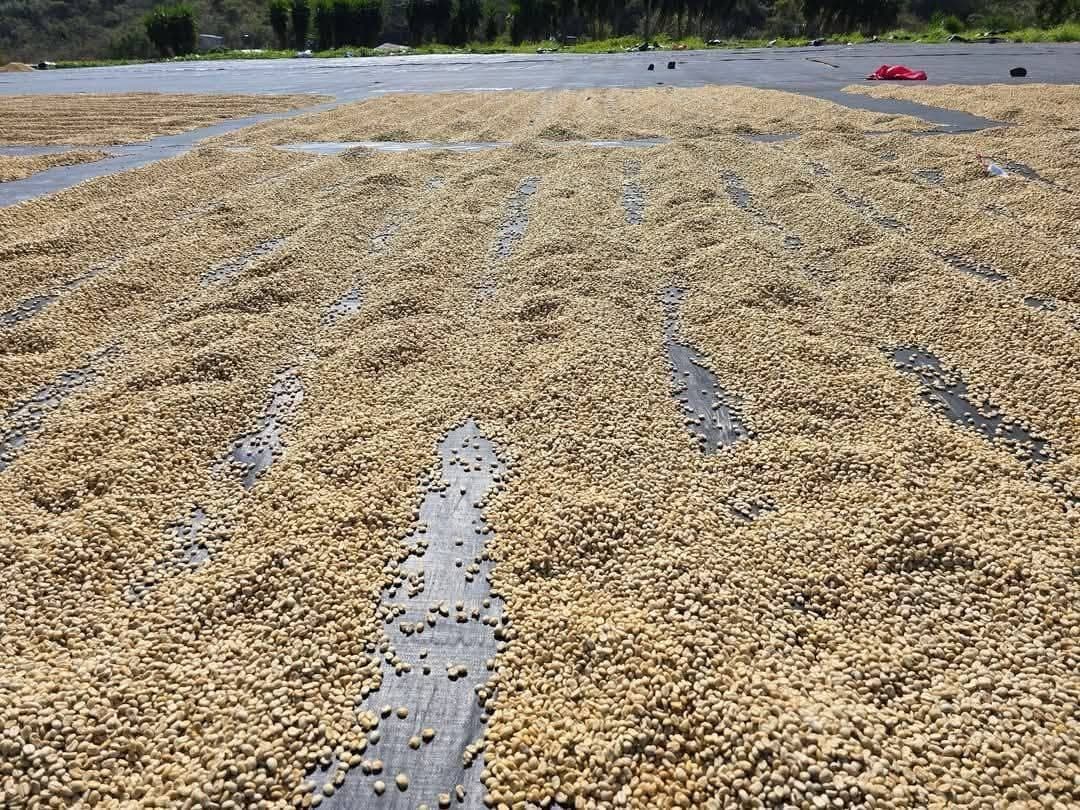
- 02Spreading whole cherry in thin layers on raised beds or patios
- 03Frequent turning, with early-stage layers kept thin to avoid mould and internal fermentation
- 04Shading or covering during peak sun and overnight to control the drying rate
- 05Drying over roughly two to four weeks depending on climate and layer depth
- 06Rest in cherry, then hulling to remove dried skin, pulp and parchment in one operation
- 07Screening, density and colour sorting at the dry mill
Honey / pulped natural
Read more about Honey processing- 01Cherry reception, floatation and sorting
- 02Pulping without a fermentation or washing step
- 03Optional partial mucilage removal — the fraction left on determines the yellow / red / black designation
- 04Drying in mucilage-coated parchment on raised beds, with very frequent turning in the first 48 hours
- 05Slower, more closely managed drying than washed parchment
- 06Rest, hulling and dry-mill sorting as for washed
Semi-washed / wet-hulled
Read more about Semi-washed processing- 01Pulping and short fermentation
- 02Partial drying in parchment
- 03Hulling while the seed is still well above final moisture
- 04Completing the drying on the exposed green bean
Method
Washed coffee
Washed coffee has had its skin and pulp removed by pulping and its mucilage removed by fermentation and washing before drying in parchment. The result is a cup with cleaner, more transparent acidity and lighter body than the same cherry dried whole — because the fruit is removed before drying rather than during it.
What washing removes, and why it matters
The essential fact about washed processing is that the fruit is separated from the seed *before* drying. The seed dries in parchment, in contact with air rather than with sugars. Whatever ends up in the cup therefore comes from the seed, the variety and the growing conditions — not from fruit fermenting against it.
- Skin (exocarp) — removed by pulping, or dried onto the seed in natural processing.
- Pulp (mesocarp) — the fruit flesh.
- Mucilage — the pectin layer whose removal defines washed, honey and natural processing.
- Parchment (endocarp) — protects the seed during drying and resting; removed at hulling.
- Silverskin — the seed coat; becomes chaff in the roaster.
- Seeds — normally two flat-faced seeds. When only one develops, the result is a peaberry.
That has a consequence that is easy to state and important to internalise: washed processing shows you the coffee. It shows the good and the bad with equal clarity. A washed lot from carelessly picked cherry has nowhere to hide, which is why washed origins invest so heavily in cherry selection and floatation at reception.
The cup
| Washed | Natural | |
|---|---|---|
| Acidity | Higher perceived, more defined | Lower perceived, rounder |
| Body | Lighter to medium, often silky | Fuller, heavier |
| Sweetness | Structured, sugar-like | Pronounced, fruit-forward |
| Origin character | Reads clearly | Partly overlaid by process character |
| Batch consistency | Higher | Lower — drying variation shows |
| Defect visibility | High — faults are exposed | Lower — process can mask, or add, faults |
The Kenyan and Burundian practice of a post-fermentation soak in clean water deserves separate mention. Extending contact time in clean water after the mucilage has broken down is associated with the clarity and structure characteristic of both origins. It is a processing decision with a real sensory signature.
Where washed processing dominates in East Africa
| Origin | Role of washed processing | Notes |
|---|---|---|
| Kenya | Effectively universal for export grades | Fermentation plus clean-water soak at cooperative factories |
| Rwanda | The default; washing stations are the core infrastructure | Bourbon-dominant, station-level lot identity |
| Burundi | The default, with soak | Traceable to the individual colline |
| Tanzania | The default for Arabica | Both northern and southern belts; naturals growing in the south |
| Ethiopia | Large share, especially Yirgacheffe and Sidama | Naturals are also a major and growing category |
| Uganda | WUGAR designation; Bugisu on Mount Elgon | Robusta is dry-processed, not washed |
Specifying a washed lot
Beyond the usual grade, screen and defect terms, washed coffee has a few specification points of its own.
- State the fermentation style if it matters to you — dry fermentation, under-water fermentation, or with a soak. These are meaningfully different and stations know which they run.
- Ask about drying substrate. Raised beds versus patio changes the drying rate and the evenness, and therefore the risk profile.
- Ask about the rest period in parchment. Coffee hulled immediately after drying behaves differently from coffee rested for several weeks.
- Set the moisture and water activity together, not moisture alone — see water activity.
- Specify the packaging. Hermetic liners matter more for washed specialty lots destined for long storage than for fast-moving commercial parcels.
Buying washed lots: washed green coffee. What happens at the wet mill: wet processing.
Method
Natural coffee
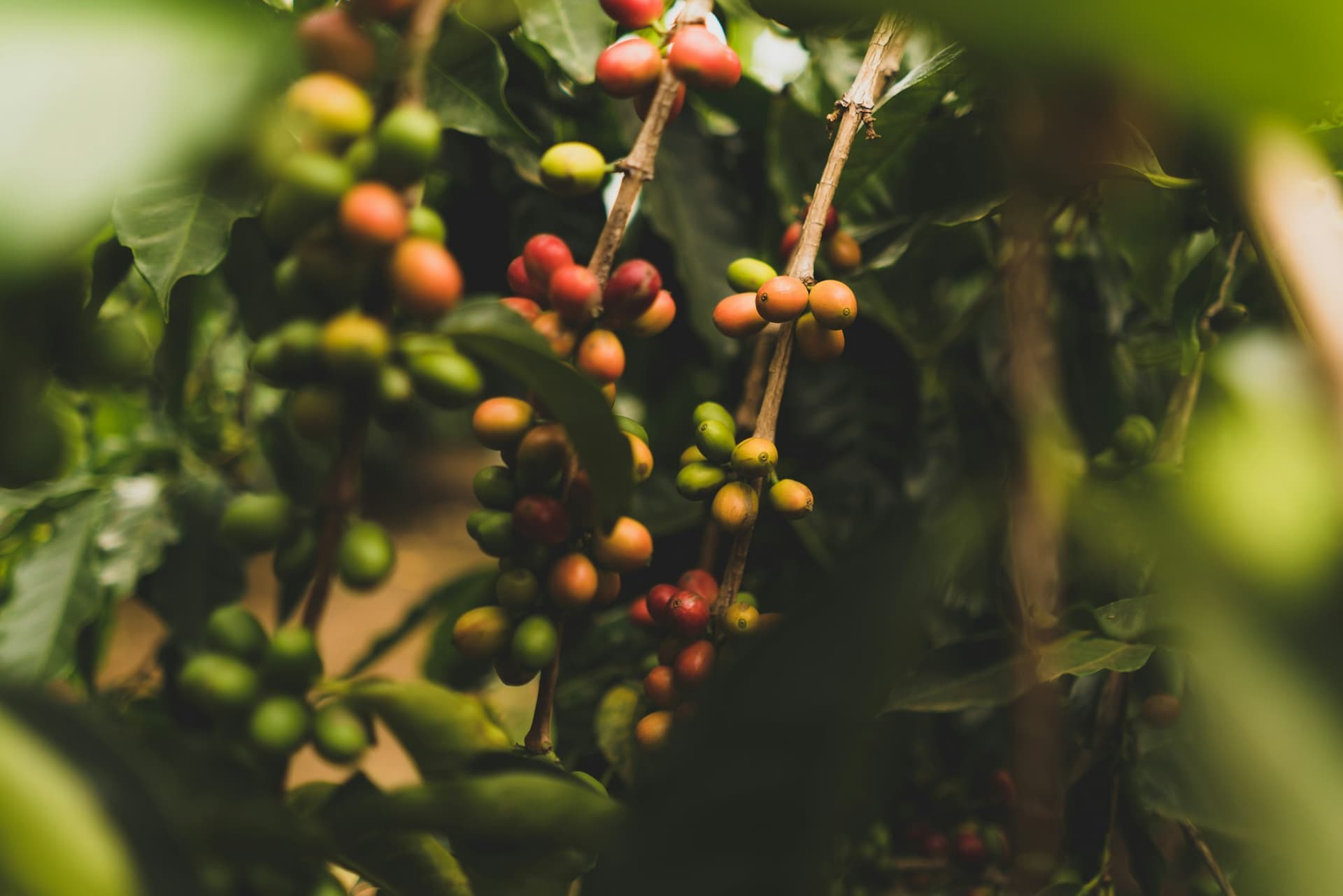
Natural coffee is dried as whole cherry and hulled afterwards, so the fruit stays in contact with the seed throughout drying. It produces heavier body, lower perceived acidity and pronounced fruit sweetness — and carries the highest execution risk of any process, because drying faults are invisible in the green and only appear in the cup.
One process, two very different products
The same nominal process — dry the whole cherry, then hull it — produces both a Grade 1 Guji natural sold on cup score and a Grade 4 Djimma sold on defect tolerance. The difference is entirely in the execution: cherry selection at reception, bed loading depth, turning frequency, and the discipline of the last three days of drying.
- Cherry reception, floatation and sorting
- Whole cherry spread thinly on beds
- Frequent turning, shaded at peak sun
- Drying over 2–4 weeks
- Rest in dried cherry
- Hulling — skin, pulp and parchment removed together
- Screening and density sorting
- Colour sorting and final preparation
This is why "natural" on its own is an under-specified word. It tells you the fruit was dried on the seed. It does not tell you whether that was a deliberate quality decision or the only option available.
Where the risk sits
The defect you cannot see
Over-fermentation and mould during cherry drying produce phenolic, medicinal and mouldy cups. Almost none of it is visible in the green bean. A natural lot can pass a screen and defect analysis cleanly and still be unusable. Cup approval on a representative sample is not optional for naturals — it is the only control that works.
- 1Reception. Floatation and hand sorting are more consequential here than in washed processing, because nothing downstream removes an under-ripe cherry.
- 2First 72 hours. Cherry is at its highest moisture and its most vulnerable. Thin layers and frequent turning are what prevent internal fermentation and mould.
- 3Mid-drying. Layer depth can increase as moisture falls, but turning must continue. Uneven beds produce uneven lots.
- 4Final days. The coffee looks finished before it is. Most over-drying and most cracked parchment damage happens in this window.
- 5Resting. Cherry is stored before hulling; storage conditions here still affect the final cup.
Illustrative only. Actual curves depend on bed loading, ambient humidity, altitude and turning frequency. The flattening tail is where over-drying risk sits — most damage happens after the coffee looks finished.
Naturals by origin
| Origin | Role | Character |
|---|---|---|
| Ethiopia — Guji, Sidama | Major specialty category | Blueberry, strawberry, tropical fruit; intense and sweet |
| Ethiopia — Harrar | Dry-processed by tradition | Wine, blueberry, heavy body; longberry and shortberry separations |
| Ethiopia — Djimma | Commercial volume backbone | Grade 4 and 5 naturals feeding blends worldwide |
| Uganda — Robusta | The standard process | Neutral to sweet, heavy body; screen-graded |
| Uganda — DRUGAR | Natural Arabica designation | Dried fig, spice, cocoa; from Rwenzori, West Nile and Kigezi |
| Tanzania — south | Growing category | Stone fruit and berry over the region’s natural sweetness |
| Kenya — Mbuni | By-product stream | Distinct from deliberate naturals; see the Kenya grades page |
Specifying a natural lot
- Insist on a representative pre-shipment sample and cup it. No other control substitutes.
- Ask whether the cherry was selected for drying or diverted to it. Deliberate naturals and by-product naturals are different products.
- Ask about bed loading and turning regime. Stations that can answer precisely are usually the ones that do it well.
- Set water activity, not just moisture. Naturals frequently run higher aw at the same moisture reading — see water activity.
- Specify hermetic packaging for specialty naturals. They are more sensitive to moisture migration in transit than washed lots.
- Agree a phenolic/ferment tolerance in the cup terms, not just a defect count in the green.
Buying natural lots: natural green coffee. What happens on the drying beds: dry processing.
Method
Honey process coffee
Honey processing pulps the cherry but leaves a controlled fraction of the mucilage on the parchment during drying. The colour names — yellow, red, black — describe how much mucilage was retained and how slowly the lot was dried, not an added ingredient. The cup sits between washed and natural: more sweetness and body than washed, more clarity than natural.
What the process does
The cherry is pulped, as in washed processing. But instead of fermenting and washing the mucilage off, some or all of it is left on the parchment, which then goes straight to the drying beds. The sugars dry onto the parchment — hence "honey", which describes the appearance and stickiness of the drying parchment, not a flavour additive.
- Cherry reception, floatation and sorting
- Pulping without fermentation
- Mucilage fraction set — yellow, red or black
- Bed drying in coated parchment
- Very frequent turning for the first 48 hours
- Slow drying to target moisture
- Rest in parchment
- Hulling, screening and sorting
| Designation | Mucilage retained | Drying | Cup tendency |
|---|---|---|---|
| Yellow honey | Least | Faster, more sun exposure | Closest to washed; clean with added sweetness |
| Red honey | Moderate | Slower, more shade | Balanced; more body and stone-fruit sweetness |
| Black honey | Most | Slowest, heavily shaded | Closest to natural; dense, syrupy, highest risk |
The naming is not standardised
There is no governing definition of yellow, red and black honey. One station’s red honey is another’s black. Where the distinction matters commercially, ask for the mucilage percentage left on and the drying duration — those are facts; the colour name is a description.
What it demands of a station
Honey processing is operationally demanding in a specific way: the parchment is sticky. In the first 48 hours it clumps, sticks to the mesh and to itself, and traps moisture wherever it does. That creates exactly the conditions mould needs.
- Very frequent turning in the first two days — considerably more than either washed parchment or whole cherry requires.
- Thin initial bed loading, which limits how much can be run at once.
- Bed space comparable to naturals, with the sorting discipline of washed.
- Skilled labour available at the right moment; the process does not tolerate being left overnight in the early stage.
This combination — high labour, high bed occupancy, moderate volume — is why honey lots are produced in small quantities in East Africa, and why they are usually a station’s deliberate experiment rather than its main line.
East African availability
Availability is genuinely limited
Honey lots are produced in small volumes across Rwanda, Burundi, Tanzania and Ethiopia. They are lot-specific and season-specific. Treat any honey requirement as something to be confirmed against the current crop rather than assumed to be available — and expect small parcel sizes.
Where honey lots do appear, they are usually from stations that already run tight washed separations and have the labour and bed capacity to experiment. That correlation is useful: a station capable of executing honey processing well is generally a station worth buying washed coffee from too.
Specifying honey lots
- Mucilage fraction
- Ask for the percentage left on, not just the colour name
- Drying regime
- Duration, shade management and turning frequency in the first 48 hours
- Water activity
- Particularly important — honey lots can hold moisture unevenly
- Parcel size
- Confirm early; honey separations are typically small
- Packaging
- Hermetic liner strongly advisable
- Cup approval
- On a representative sample, as for naturals
Buying honey lots: honey process green coffee.
Specifying
Writing the process into a contract
- Name the preparation exactly. “Fully washed” and “fully washed with soak” are different processes with different cups. Kenya and Burundi soak as standard; most other origins do not.
- Do not infer process from origin. Ethiopia, Tanzania and Uganda all produce both washed and natural at scale. An unspecified Ethiopian lot is not a specification.
- For naturals, cup more cups. Drying faults are intermittent across a lot and invisible in the green. A three-cup sample can miss what a five-cup sample finds.
- Tie it to the approved sample. The process name sets the expectation; the retained sample is what the delivery is measured against.
What we operate, and what we do not
We run a dry mill in Kampala for Ugandan coffee — hulling, grading, sorting and bagging, described on our processing facility page. We do not operate washing stations or drying yards; wet and dry processing at the six origins is done by cooperatives, stations and estates, and this guide describes how it works there generally.
Questions