Roasted Coffee
Bulk Roasted Coffee From East Africa
Quick answer
Bulk roasted coffee may be supplied from the same East African green coffee we export, for distributors, industrial buyers and foodservice channels, according to product specification and commercial availability. It is a secondary category: the primary business is green coffee at origin.
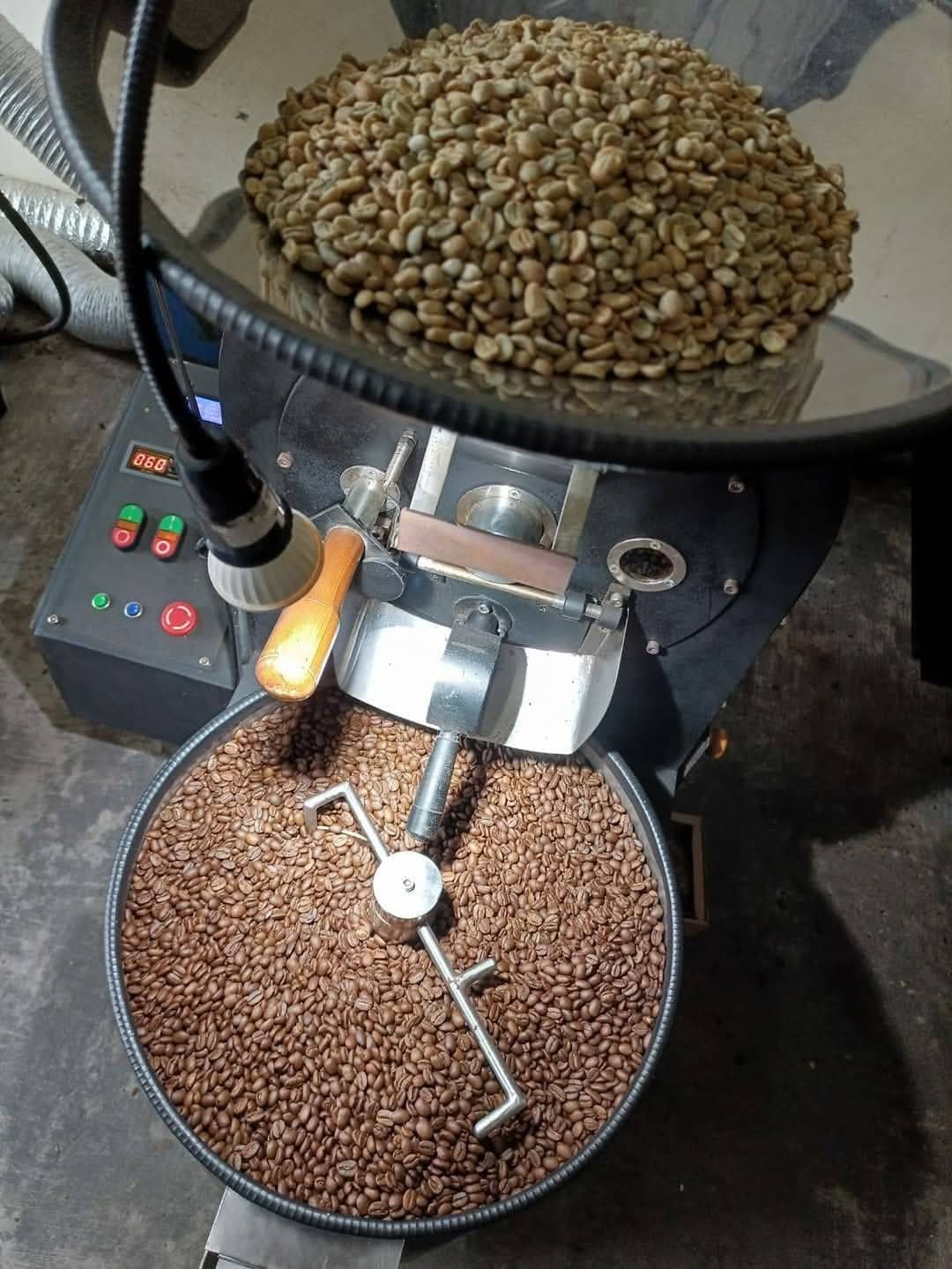
Roasting and grinding fall within the ISO 22000:2018 food safety certification held for our processing facility in Kampala (certificate AMER35998, valid to December 2028; a copy is available on request). That is a statement about the certified scope, not about capacity or lead time, which are confirmed per enquiry.
Who this is for
This is a business-to-business bulk category. The buyers it serves already have a route to market and need coffee to fill it.
- Importers and distributors placing roasted product into a regional market where roasting locally is not economic at the volume concerned.
- Foodservice and hospitality wholesalers supplying an existing account base under their own commercial arrangements.
- Industrial and food manufacturers using roasted or ground coffee as an input rather than as a finished good.
- Buyers already contracting our green coffee who want part of a programme delivered roasted.
What this is not
We do not offer private label, OEM brand creation, packaging design, artwork approval or consumer brand development. There is no retail range, no subscription and no consumer pricing. If you need a brand built rather than coffee supplied, we are the wrong supplier and will say so at the first email rather than the fifth.
The four things a roasted specification must fix
A green coffee contract is well-understood territory: grade, screen, defects, moisture, crop, cup. A roasted contract needs all of that *plus* four more decisions, and disputes almost always trace back to one of them being left implicit.
Beyond the green specification
- Step 1
Roast degree, stated measurably
Named roast levels — "medium", "city", "Italian" — do not survive contact with a second party. Fix the roast against an agreed retained reference sample, and where instrumentation exists on both sides, against a colour value on a stated scale and instrument. Two different colour meters do not agree with each other, so name the instrument.
- Step 2
Whole bean or ground, and if ground, how ground
Grind is a distribution, not a number. Specify the target application and the reference setting, and agree tolerance on the sample rather than on an adjective. See the ground coffee page.
- Step 3
Packing format and net weight
Bulk sack, multi-wall bag, lined carton or valve bag — the choice follows the destination handling and shelf life required, and it changes both the price and the container maths.
- Step 4
Degassing and packing window
Roasted coffee releases CO₂ for days after roasting. How long it rests before packing, and whether the pack carries a one-way valve, determines whether the bags arrive intact. This is a specification item, not a detail.
Product specification fields
What a roasted enquiry should carry
- Green coffee origin
- Country and region, exactly as for a green contract
- Species
- Arabica, Robusta, or a stated blend ratio
- Green specification
- Grade, screen, defect basis, crop year
- Process
- Washed, natural or honey — it survives the roast and drives the profile
- Roast degree
- Against a retained reference sample; colour value and instrument where used
- Format
- Whole bean or ground
- Grind
- Target application plus reference setting, where ground
- Packing
- Format, net weight, valve, liner, carton configuration
- Quantity
- Per shipment and, where relevant, per call-off across a period
- Destination and Incoterm
- Port or delivery point, and the term — see Incoterms
- Shipment window
- Required production and shipment dates
Single-origin roasted coffee
Single origin means the coffee comes from one stated place. What it does not tell you is how tightly that place is defined — country, region, cooperative, washing station and day lot are all “single origin”, and they are not equivalent claims.
Five things all called "single origin"
Each of these is a legitimate use of the term, and each supports a very different claim to a customer. The distinction matters most when the claim is printed on something.
| Level | What it fixes | What still varies |
|---|---|---|
| Country | One country of origin | Region, altitude, process, producer, crop timing — everything else |
| Region | A named growing area | Producer, station, altitude band, process detail |
| Cooperative / union | One member organisation | Which member farms and which deliveries were included |
| Washing station / factory | One processing site | Which delivery days were combined into the lot |
| Day lot / micro-lot | One site, one narrow delivery window | Very little — this is the tightest routinely available separation |
Specify the level, not just the word
A single-origin contract should name the level explicitly. "Single origin Ethiopia" and "single origin, Yirgacheffe, one washing station, one delivery period" are both true statements and one of them is worth considerably more than the other.
The practical rule: state the tightest level you can actually evidence, and no tighter. Overstating traceability is the single easiest way to lose a commercial relationship, because it is verifiable and it will eventually be verified.
What we will and will not confirm
We will confirm the traceability level that the documentation for a given lot actually supports, and we will say plainly when a tighter claim is not evidenced. We will not supply a station name for a coffee assembled from several, or a farm name for a cooperative lot.
Continuity
Single-origin roasted programmes have a structural problem that blends do not: the coffee runs out, and next year’s crop from the same place is a different coffee. The tighter the separation, the smaller the lot and the sooner it happens.
- Contract the volume for the season at the point the lot is approved, rather than buying repeatedly against a shrinking parcel.
- Agree a named successor in advance — usually the same station, next crop — and accept that it will cup differently.
- Where a fixed profile matters more than a fixed place, a blend is the honest answer and a single-origin label is not.
- Consider East Africa’s staggered harvests: the region’s harvest windows barely overlap, so a rotating single-origin programme across origins can run year-round. See the crop calendar.
Why the green decisions still dominate
Roasting is a transformation, not a correction. It sets how much of the coffee’s potential is expressed and it can certainly destroy quality, but it cannot add character that the green coffee did not have. A parcel with a high defect count roasts into a cup with a high defect count. Baked, under-developed or scorched roasting turns a good green coffee into a poor product.
The practical consequence for a buyer is that a roasted enquiry should specify the green coffee at least as carefully as a green enquiry would — which is why every page in this section links back into the green coffee specifications rather than restating them loosely.
Availability
Bulk roasted and ground coffee is supplied subject to product specification, origin availability, roasting capacity and commercial agreement. Nothing on this page is an offer or a confirmation of stock — availability, lead time and minimum quantity are confirmed per enquiry.
Bulk roasted enquiries
Send the origin, species, roast reference, format, packing and quantity. Where the specification is not yet fixed, describe the application and we will propose one.
Request Coffee OfferBulk roasted categories
- Bulk Roasted Arabica CoffeeBulk roasted Arabica may be supplied from the East African origins we export green: Ethiopia, Kenya, Tanzania, Rwanda, Burundi and Ugandan Arabica. Roast degree is fixed against a retained reference sample, and the green specification underneath it is contracted exactly as a green parcel would be.
- Bulk Roasted Robusta CoffeeBulk roasted Robusta may be supplied primarily from Ugandan and Tanzanian (Kagera) green Robusta. It is bought for body, crema and price stability in espresso blends and for industrial applications, and is specified by screen and defect basis before the roast is discussed.
- Bulk Whole Bean Roasted CoffeeWhole bean is the default format for bulk roasted coffee because it degrades far more slowly than ground coffee. The specification questions are packing format, degassing time before packing, and whether the pack is valved, flushed or both.
- Bulk Ground CoffeeGround coffee may be supplied in bulk where the destination cannot grind or the application requires it. Grind is specified as a target application plus an agreed reference sample, not as a single number, because every grinder produces a distribution of particle sizes rather than one size.
Frequently asked questions
Do you supply roasted coffee under our own brand?
Does single origin mean better roasted coffee?
Can you supply the same single origin every year?
Is roasted coffee your main business?
What is the minimum quantity for bulk roasted coffee?
Should I buy green and roast locally, or buy roasted?
Tell us the coffee you need
Lots can be specified by origin, region, process, grade, screen, moisture, defect tolerance, crop year and packaging. Send what you know and we will confirm what each origin realistically supports.