Tanzania · Grade
Tanzania Peaberry
- Species
- Arabica · Robusta
- Preparation
- Fully washed · Natural
- Harvest
- June–October in the south; July–December in the north
Quick answer
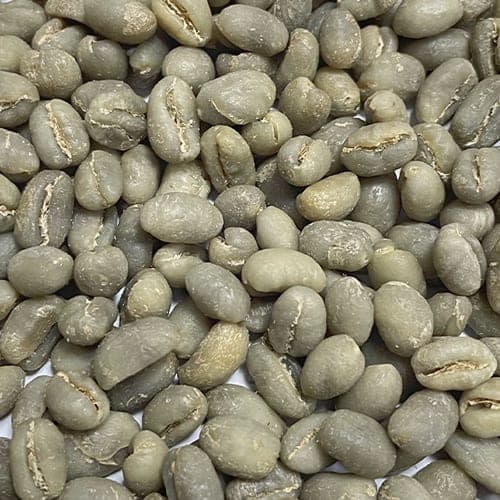
A peaberry forms when only one of the two ovules in a cherry develops, producing a single rounded seed instead of two flat-faced ones. Tanzania has a long-established peaberry separation, done on slotted screens. It is a shape class, not a quality class — the reason to buy it separately is that it roasts differently.
Contract on: region · grade · screen · process · crop · moisture · defect tolerance · cup approval.
Request current tanzania peaberryWhat a peaberry is
A normal coffee cherry contains two seeds with flat facing sides. When only one of the two ovules is fertilised or develops, the single seed grows into the available space and takes a rounded, oval form. That is a peaberry.
It occurs naturally in a small proportion of any harvest, across every origin and variety. It is not a variety, not a defect, and not a sign of anything about the tree or the farm.
- Skin (exocarp) — removed by pulping, or dried onto the seed in natural processing.
- Pulp (mesocarp) — the fruit flesh.
- Mucilage — the pectin layer whose removal defines washed, honey and natural processing.
- Parchment (endocarp) — protects the seed during drying and resting; removed at hulling.
- Silverskin — the seed coat; becomes chaff in the roaster.
- Seeds — normally two flat-faced seeds. When only one develops, the result is a peaberry.
How it is separated
Peaberries are separated on slotted screens rather than round-hole ones. A round seed passes through a slot that a flat bean of the same nominal width will not, which is what makes the separation possible. Peaberry therefore runs on its own screen scale — a PB 13 or 14 is not comparable to a flat-bean screen 13 or 14.
Tanzania has a long-established and carefully executed peaberry separation, which is why Tanzanian PB has a market identity that peaberry from many other origins does not.
Why it roasts differently
This is the real, defensible reason to keep peaberry separate.
- Geometry. A rounded seed has a different surface-area-to-mass ratio from a flat-faced one, so heat enters differently.
- No flat face. Flat beans present a flat surface to the drum and to each other; peaberries roll. Bed behaviour in the roaster differs.
- Higher bulk density. Rounder seeds pack more closely, so the same volume weighs more — which affects charge calculations.
- Uniformity. A peaberry separation is inherently uniform in shape, which is an advantage on a tight profile.
Mixed into a flat-bean batch, peaberries develop out of step with the rest. Separated, they roast very evenly. That is the practical case.
What it is not
Peaberry is not intrinsically better coffee
It comes from the same cherry, the same trees and the same processing as the flat beans around it. The claim that the single seed "concentrates" the flavour that would have gone into two is not supported — the seed is not larger in total mass than the pair it replaces. Buy peaberry because it roasts uniformly and because you like the specific lot, not because of the concentration story.
Availability and price
Peaberry is a small proportion of any harvest, so parcels are limited by nature rather than by choice. That scarcity, combined with the extra separation step, is what drives the differential.
- Typical parcel
- Small — tens of bags rather than containers
- Screen
- Own PB run, commonly PB 13/14
- Regions
- Produced across both Tanzanian belts; southern lots lean sweeter
- Processing
- Fully washed
- Packaging
- 60 kg jute, hermetic liner common
Peaberry enquiries
Tell us the region and volume. Peaberry parcels are small, so early confirmation matters.
Request Current Crop OfferThe distinction that matters
What this grade does not tell you
A grade is a preparation class. Everything below is a separate contract field, and every one of them moves independently of the grade name.
What it does fix
Tanzania Peaberry encodes
- Bean size, as the screen the parcel is retained on
- Bean shape, where peaberry is separated from the flat-bean run
- Density, for the TT separation lifted off the AA/A/B run
- That the parcel met the preparation standard of a named grade
Use the grade to define the physical deliverable. Use the approved sample to define the cup. Both belong in the contract.
What it does not
Specify these separately
- Cup qualityTwo lots at the same grade from the same mill can cup several points apart. Only cupping tells you.
- Defect countA separate count on a defined sample, against a weighting table that differs by origin.
- MoistureA range plus the measurement method. Two meters on one parcel routinely disagree.
- Crop yearNothing in a grade name distinguishes current crop from a parcel that has been in store a year.
- DensityBulk density in g/L, which drives charge temperature and roast planning.
- Water activityStorage stability. Related to moisture but not derivable from it.
- TraceabilityCountry, station or day lot are different claims. A grade fixes none of them.
- Processing methodWashed, natural and honey can all carry the same grade at most origins.
Questions
Frequently asked questions
What is a peaberry?
Does peaberry coffee taste better?
Why is Tanzanian peaberry well known?
How much peaberry is available?
Keep reading
Related to Tanzania Peaberry
- Coffee Screen SizesCoffee screen size chart with mm conversion, how sizing tolerances work, what screens 15–18 mean in East African grades, and how bean size affects roasting.
- Green Coffee DensityGreen coffee density explained: how bulk density is measured in g/L, what it does and does not tell you about altitude and quality, and how it is used in dry milling.
- Tanzania Coffee GradesThe Tanzanian grade ladder for washed Arabica — AA, A, AB, B, C, PB, E, TT and UG — how each separation is produced, and how Kagera Robusta differs.
- Kenya PB (Peaberry)Kenya PB peaberry: how the separation is made, why the rounded seed roasts differently, availability and how to specify it.
- Tanzania Green CoffeeTanzanian green coffee from the northern and southern highlands plus Kagera Robusta — grades, regions, harvest windows, cup profiles and how to specify a Tanzanian parcel.
Request an offer
Tell us the Tanzania coffee you need
Region, process, grade, screen, moisture, defect tolerance, crop year, packaging and destination. Send what you know and we will confirm what Tanzania realistically supports for the current crop.