Operations
Coffee processing and export
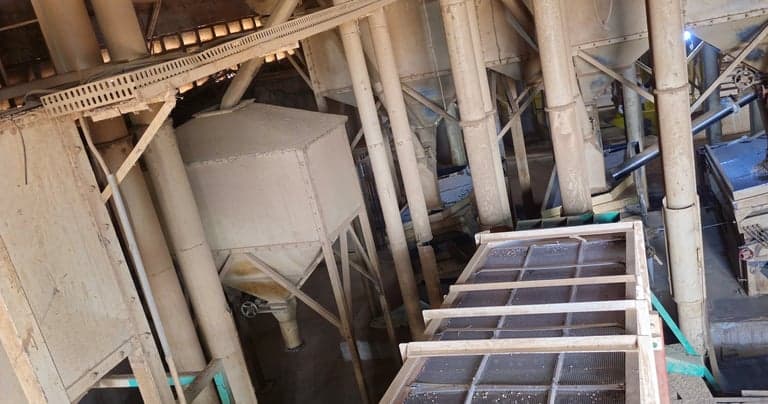
What we run
Our dry milling and export operation is in Kampala, Uganda. Coffee is sourced by our own field analysts, milled and prepared in our facility, evaluated before it is committed to a contract, and loaded under supervision. Registration, inspection and export certification sit with Uganda’s Ministry of Agriculture, Animal Industry and Fisheries, which took over the coffee functions of the former Uganda Coffee Development Authority in January 2025.
Preparation is not a finishing step applied to whatever arrives. It is a series of separations, and each one can only work with the coffee it is given. That is the honest frame for everything below: milling decides how cleanly a lot is presented, and sourcing and drying decide how good it was to begin with.
The line
From delivery to sealed container
What happens at each step, and what it means for the coffee you receive.
- 01
Sourcing
Field analysts buy directly from farmers, farmer groups and cooperative stores, assessing moisture and outward condition at the point of purchase rather than accepting a delivery and discovering the problem at the mill.
Why it matters — Rejecting wet or poorly dried coffee at purchase is the cheapest quality control there is. Once under-dried coffee is in a bulk pile, nothing downstream recovers it.
How lot identity is kept - 02
Reception and moisture control
Deliveries are weighed in, sampled and checked for moisture before they join a milling batch. Coffee outside the acceptable moisture band is held for further drying rather than milled.
Why it matters — Moisture is the parameter that determines whether a coffee survives eight weeks in a container. It is set here, not at the port.
Moisture and water activity - 03
Hulling
Dried cherry and parchment are hulled to remove the husk and parchment layer, releasing the green bean. Robusta arriving as dried cherry and Arabica arriving as parchment are run separately.
Why it matters — Huller setting is a trade-off. Run tight and you break beans; run loose and parchment carries through into the finished lot. Both show up in a defect count.
- 04
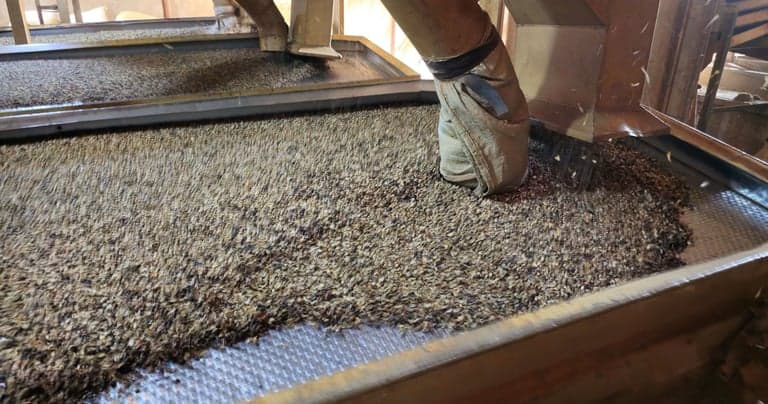
Cleaning
Hulled coffee passes over vibrating screen decks and through aspiration, which lift out husk, chaff, dust, stones and foreign matter. This is where the bulk of non-coffee material leaves the stream.
Why it matters — Foreign matter is the fastest way to fail an arrival inspection, and it is a food safety issue before it is a quality one.
 04
04Coffee spreading across a vibrating screen deck, chaff separating from the beans. - 05
Grading and screen separation
Cleaned coffee is separated by size over perforated screens and by density over gravity tables, then discharged into the separate grade streams a contract calls for — screen 18, screen 15, and the smaller and lighter fractions.
Why it matters — A screen specification is only meaningful if the mill can actually hold it. Where a requested screen class cannot be filled at the volume asked for, we say so at enquiry stage rather than at shipment.
What screen sizes mean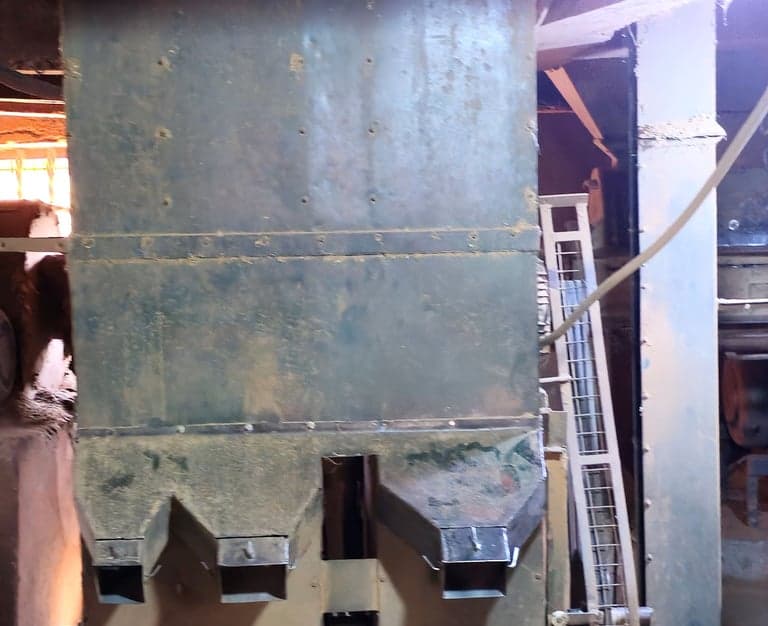 05
05A separator discharging graded coffee through its outlet chutes. - 06
Optical colour sorting
Graded coffee runs through optical sorters that eject beans falling outside the accepted colour range — blacks, sours, insect damage and remaining foreign material — by air jet as the stream falls past the cameras.
Why it matters — Colour sorting is what takes a lot from a field grade to a contract defect count. Passes can be repeated where a tighter count is contracted, at the cost of outturn.
Defect classification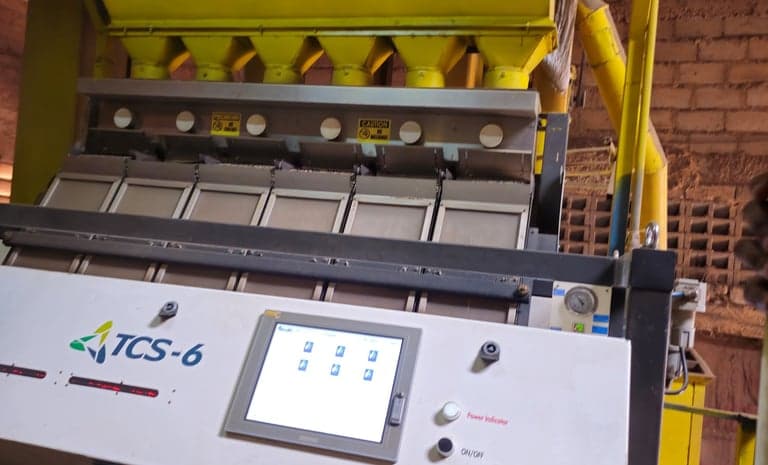 06
06An optical colour sorter in operation, feed chutes above the ejection chambers. - 07
Quality evaluation
A sample is drawn from the finished lot for physical analysis — moisture, screen distribution, defect count, bean appearance — and for cup evaluation. Results are reported with the method stated so they are comparable with the buyer’s own analysis.
Why it matters — Physical analysis establishes that a parcel is what it says it is. Only cupping establishes what it will do in a blend or a roast profile.
Quality assurance workflow - 08
Bagging and storage
Finished coffee is bagged to the contracted presentation — 60 kg jute as standard, hermetic liners where the coffee warrants them — marked, and stacked on dunnage in the warehouse clear of walls and floor.
Why it matters — Most quality lost after milling is lost in storage. Stack ventilation and liner choice do more for arrival condition than anything added later.
Packaging options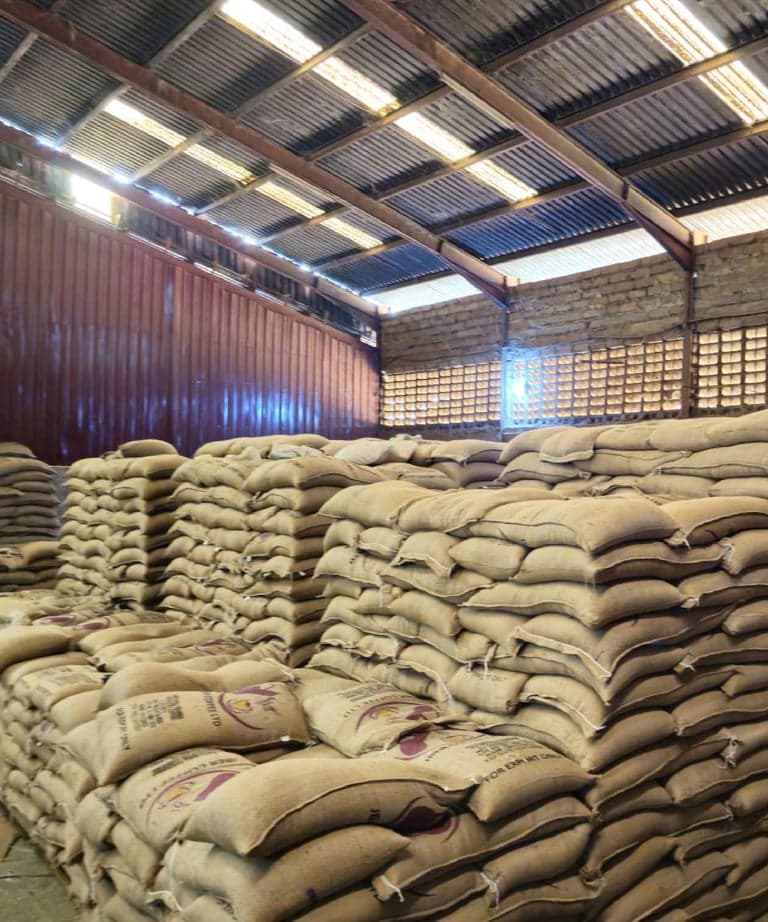 08
08Finished lots stacked in the warehouse, bags marked with the lot identity. - 09
Loading and export
Containers are inspected for cleanliness, odour and watertightness before stuffing, lined where the coffee requires it, and loaded under supervision. Bag count, weights, seal number and photographs are recorded as the container is closed.
Why it matters — That loading record is what resolves an arrival dispute. Without it, a short-landed or condensation-damaged container becomes one party’s word against the other’s.
Container loading in detail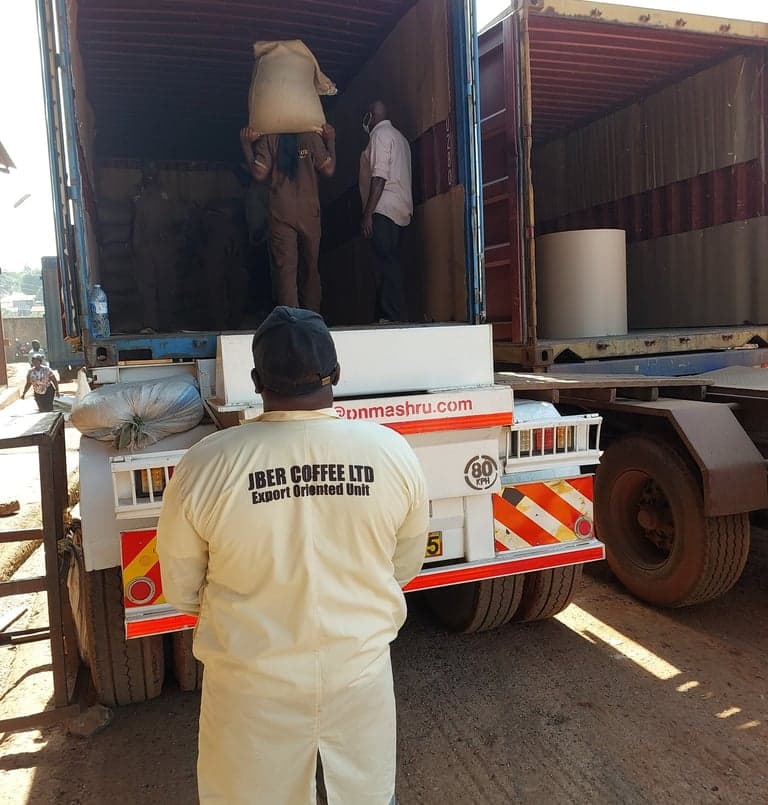 09
09Loading a container for export.
What milling can and cannot change
This distinction decides which specifications are worth writing into a contract and which ones are wishful. It is worth being blunt about, because a buyer who expects preparation to fix a sourcing problem will be disappointed at the cupping table rather than at the inspection.
Milling changes this
- Screen distribution and uniformity of bean size
- Density separation, and the removal of light and broken beans
- Defect count — blacks, sours, insect damage, foreign matter
- Colour consistency across the lot
- Cleanliness: husk, chaff, stones and dust
- Final moisture, within a narrow range
Milling cannot change this
- Variety, altitude and the growing conditions of the crop
- Fermentation character set during processing at the washing station
- Damage from over-fast or interrupted drying
- Baggy, woody or faded character in a coffee held too long
- The cup score ceiling of the underlying lot
- Whether a supply base has the geolocation data a regulation requires
A tighter defect count is always available and always costs outturn. Where a specification requires more sorting than the incoming crop justifies, the honest answer is a higher price or a different grade — not a promise made at contract and discovered at arrival.
Oversight
Supervision, food safety and market access
What is externally verified, stated precisely enough to be checked.
Regulatory oversight
Ugandan coffee export is regulated by the Ministry of Agriculture, Animal Industry and Fisheries (Coffee Department), which absorbed the functions of the Uganda Coffee Development Authority in January 2025. Exporter registration, inspection and export certification are statutory requirements rather than voluntary accreditations, which is what makes them worth stating.
ISO 22000:2018
The Kampala facility holds a food safety management system certification to ISO 22000:2018 under certificate AMER35998, valid to December 2028. The certified scope covers raw material handling, sorting, roasting and grinding, packaging, storage and distribution. The certificate is issued against the facility address shown above, not against the registered office.
A copy of the certificate is available on request.
China market registration
Registration UG/GACC/2025/0071 to export coffee and sesame to China was granted in January 2025 through Uganda’s Ministry of Agriculture, Animal Industry and Fisheries, following a sanitary and phytosanitary audit under the Plant Protection and Health Act 2016. It was issued for one year and is renewable on application, so ask us to confirm its current status before contracting a China shipment.
These apply to the Ugandan facility and to coffee exported from Uganda. Lots shipped from Tanzania, Kenya, Ethiopia, Rwanda and Burundi are governed by those countries’ own regulators and export certification systems, and we will tell you which applies to a given shipment before contract.
Where the other five origins are milled
We do not claim to operate mills we do not operate. Outside Uganda we work with established dry mills at origin, and in Kenya and Ethiopia the national marketing systems handle much of the preparation before a lot reaches an exporter at all.
What travels with us across all six origins is the specification discipline: the same pre-shipment analysis, the same reporting format, the same loading record, and the same willingness to say when a requested preparation is not achievable this crop. That consistency is most of the argument for consolidating East African sourcing through one relationship rather than six.
Origin profiles and grading systemsQuestions
Processing and preparation
Do you mill the coffee yourselves?
Can you prepare to a specific screen and defect count?
Is the coffee processed under any regulatory supervision?
Do you handle products other than coffee?
Can we inspect the facility or appoint a third-party surveyor?
What happens to the coffee removed during sorting?
Send us the preparation you need
Screen, defect count, moisture, packing and destination. We will tell you what is achievable against the current crop before we quote a price.
Keep reading
Related
- Quality AssuranceThe quality control workflow applied to every lot before shipment.
- Coffee Processing MethodsWashed, natural and honey processing explained — what each does to the cup, where the risk sits and how to specify it.
- Coffee Grades ExplainedWhat a green coffee grade encodes and leaves out, with the grading systems of six East African origins side by side.
- Coffee ExportPackaging, container loading, documentation, inspection and Incoterms.
- TraceabilityWhat each level of coffee traceability means and what evidence supports it.
- CompanyWho we are, how we source, and how quality is controlled before a container is sealed.